

More Effective Than a Cupcake: Why Feminist Dystopian Fiction Matters Now More Than Ever
The books that shaped the genre, and inspired my own novel, Queentide.

International Women’s Day has just passed, which means many workplaces have performed their annual ritual: a morning tea, a cupcake, perhaps a well-meaning speech about empowerment. None of this is bad, exactly. But it often feels a little… symbolic, and largely ineffective.
Because the realities many women face—violence, political backlash against rights, shrinking freedoms—are not symbolic problems. They are structural ones. And they are back on the rise.
Which may be why feminist dystopian fiction continues to resonate so strongly. It asks the hard questions: what happens when political rhetoric about security, tradition, or stability becomes a justification for removing rights? How do ordinary people respond when democratic norms begin to erode? What can resistance look like?
When I first wrote Queentide in 2020, these questions felt more theoretical as we tried to anticipate what the world might look like if the wrong people got/stayed in power. But now, in the harsh reality of 2026, those questions are being asked because people need answers. They need hope. They want to know how you live through—and change—a world that feels unsafe.
And that’s why feminist dystopian novels can do more than a thousand corporate cupcakes ever will. They force us to confront uncomfortable truths about power, gender, and the fragility of freedom—and to ask ourselves: what would you do?
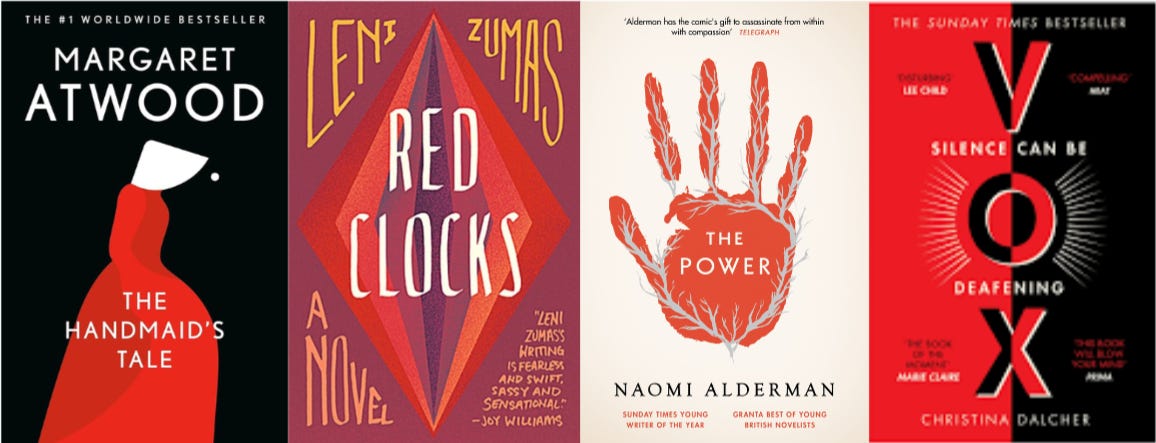
One of the most influential—and famous—novels in the genre is 1985’s The Handmaid’s Tale by Margaret Atwood. The novel imagines the theocratic state of Gilead, where women’s autonomy has been systematically dismantled in response to social crisis. What makes the story so unsettling is how plausible its world feels. Atwood famously grounded the novel in historical precedents, reminding readers that authoritarian systems rarely emerge out of nowhere—they grow from existing political and cultural currents.
Another powerful exploration of gender and power appears in The Power by Naomi Alderman, published in 2016. Alderman flips traditional gender dynamics by imagining a world where women suddenly develop the ability to generate electric shocks, and so physically dominate men. What begins as a fantasy of empowerment quickly becomes something more complicated, raising the uncomfortable possibility that power itself—regardless of who holds it—can reproduce violence and domination.
Then there’s the 2018 novel Vox by Christina Dalcher, which imagines a society where women are limited to speaking just one hundred words per day. The premise is chilling precisely because it shows how authoritarian control can begin with policies that seem narrowly targeted but quickly expand into broader systems of repression.
And in another 2018 novel, Red Clocks, Leni Zumas explores a near future where reproductive rights have been dismantled through legal and political change. Rather than focusing on dramatic upheaval, the novel shows how dystopian realities can emerge gradually through legislation, cultural pressure, and the erosion of long-standing freedoms.
Each of these novels begins with a different premise, but all of them remind us that rights are rarely lost all at once. These stories show how they erode slowly, through fear, complacency, and the normalization of policies that once would have seemed unthinkable.
Sound familiar?
Which is why these novels still matter. In fact, they may matter even more today than when they were first published.
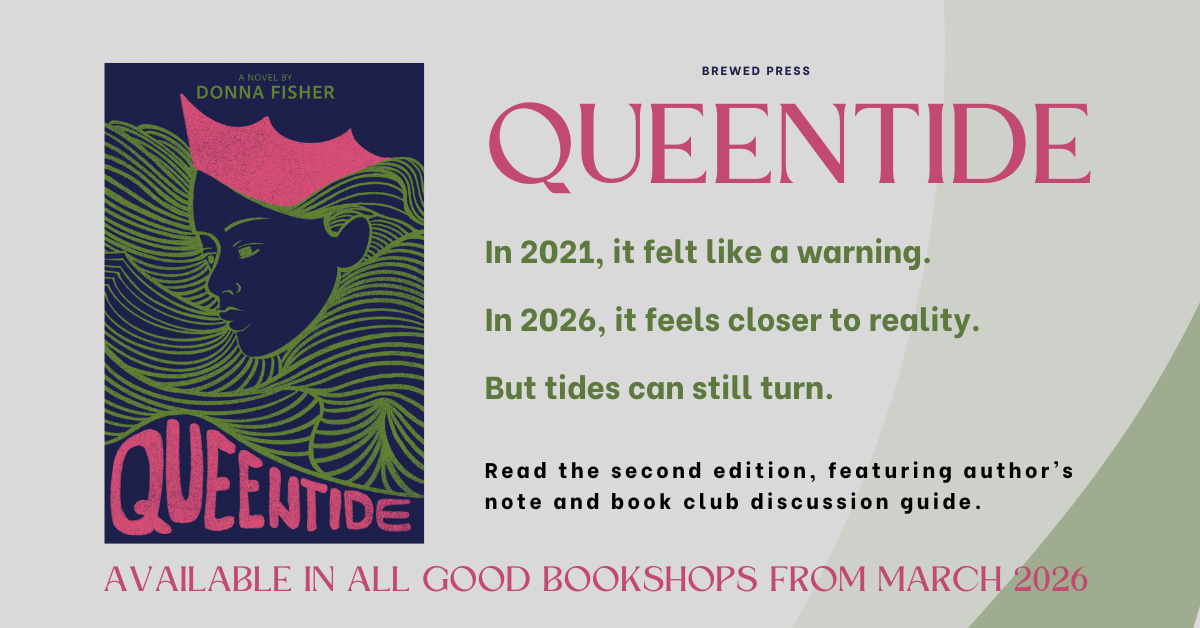
When I first published my feminist dystopian novel Queentide, it felt like I was writing a warning. The story imagines an Australia that has slipped into authoritarianism: violence against women has escalated, misogyny goes unchecked, and freedoms are steadily eroded in the name of national security. Some women adapt to the new reality. Others begin to resist. And a few begin to realise that what’s under threat isn’t only women’s rights—it's everyone’s.
Now, in 2026, it sometimes feels as though Queentide was less a warning and more a prediction. I got the country wrong (the story is set in Australia) but the political shift has materialised in other countries, and is beginning to take root in Australia. (The second edition of Queentide, coming out this month, contains an author’s note reflecting on this, and a book club guide to steer conversations.)
People are no longer asking themselves the theoretical question of what they would do when faced with an unjust system. For many people around the world, this is now their reality.
So what can these books offer, now that dystopias feel uncomfortably close to reality?
They can force us to confront the present. They can challenge us to see the world through a broader lens, and to understand the consequences of allowing women’s rights to be eroded…not only for individuals…not only for women…but for entire societies.
And that, I think, is far more powerful than a cupcake could ever be.
The second edition of my feminist dystopian novel, Queentide is available for pre-order now, in paperback and ebook.
Great post, Donna. It reminds me of this:
“The point is not for women simply to take power out of men’s hands, since that wouldn’t change anything about the world. It’s a question precisely of destroying that notion of power.”
― Simon De Beauvoir
Donna, I appreciate this reminder that fiction can be a form of cultural foresight. Feminist dystopian stories often illuminate the human cost of political shifts in ways that statistics cannot. This makes me even more curious about Queentide. Looking forward to reading it!